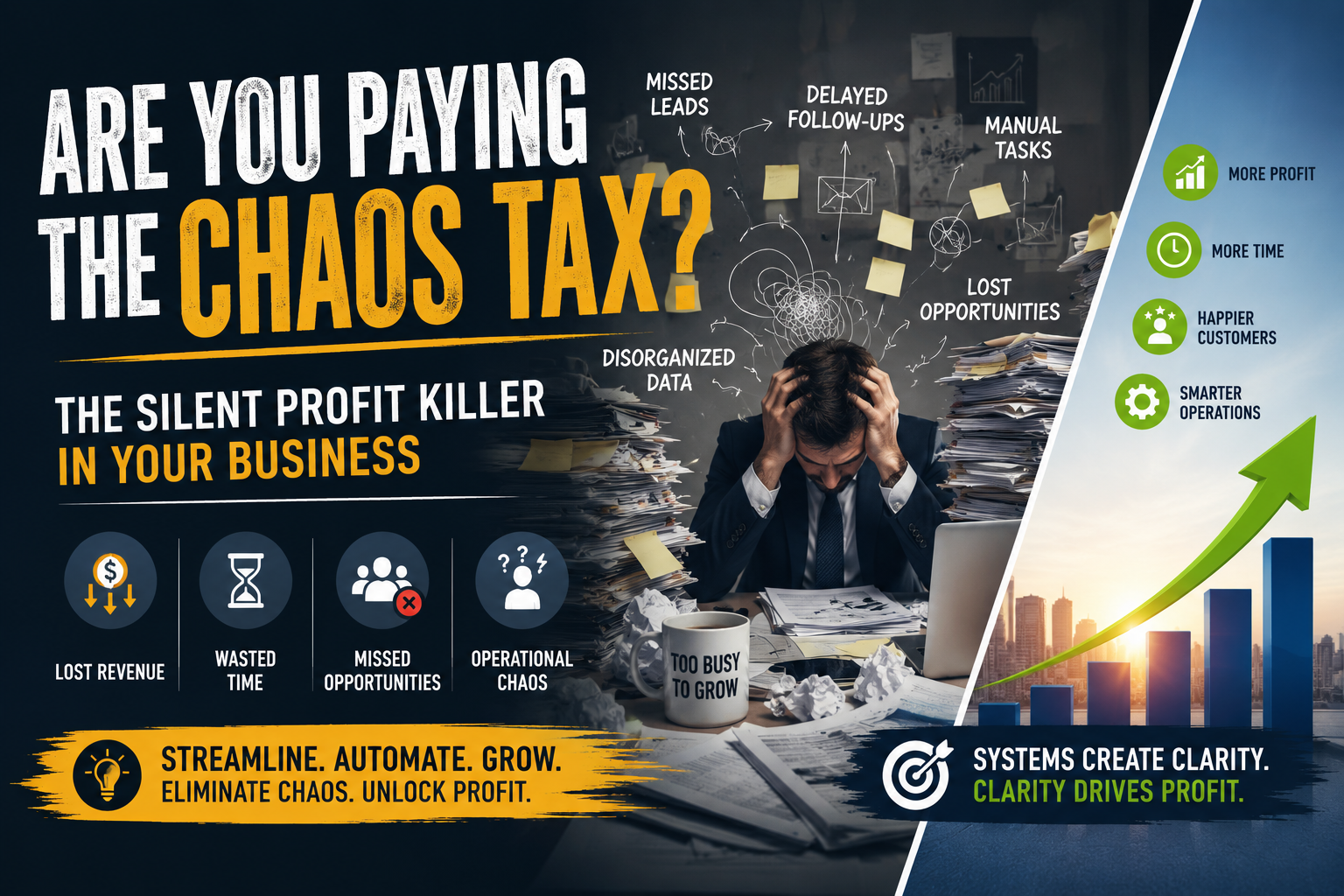
Most business owners closely monitor visible expenses such
as salaries, rent, software subscriptions, advertising costs, and operational
overheads. However, there is another expense silently draining profits every
single day—an expense that rarely appears on financial statements but
significantly impacts revenue, productivity, and growth.
This hidden expense is known as the Chaos Tax.
The Chaos Tax is the cumulative cost of inefficiencies, poor
processes, communication gaps, manual work, missed opportunities, delayed
decisions, and operational confusion. Unlike traditional expenses, business
owners often don't realize how much money is being lost until the damage
becomes substantial.
If your business constantly struggles with missed
follow-ups, delayed responses, duplicated work, inconsistent customer
experiences, or employee inefficiencies, you are likely paying the Chaos Tax.
The good news is that this silent profit killer can be
identified, measured, and eliminated.
What Exactly Is the Chaos Tax?
The Chaos Tax refers to the financial losses caused by
disorganized operations and inefficient business processes.
Unlike direct expenses, the Chaos Tax hides inside everyday
business activities:
- Lost
sales opportunities
- Missed
customer inquiries
- Manual
data entry
- Duplicate
work
- Communication
breakdowns
- Delayed
approvals
- Poor
lead management
- Lack
of automation
- Employee
confusion
- Inaccurate
reporting
Individually, these issues may seem minor. Collectively,
they can cost businesses thousands—or even millions—of dollars annually.
The Hidden Revenue Leaks Created by Chaos
1. Missed Leads and Slow Follow-Ups
Studies consistently show that businesses that respond
quickly to inquiries significantly improve conversion rates.
Imagine receiving 100 qualified leads each month. If poor
processes cause your team to miss just 15% of those leads, the impact can be
enormous.
Example:
- 100
leads per month
- Average
deal value: $1,000
- Missed
leads: 15
Potential monthly revenue loss:
15 × $1,000 = $15,000
Annual revenue loss:
$15,000 × 12 = $180,000
Many businesses lose revenue not because of poor products or
services but because follow-up systems are broken.
2. Employee Productivity Loss
Employees spend a surprising amount of time searching for
information, correcting mistakes, attending unnecessary meetings, and
performing repetitive manual tasks.
Consider a team of 10 employees.
If each employee wastes only 1 hour daily due to inefficient
processes:
- 10
hours lost per day
- 50
hours lost per week
- 2,600
hours lost per year
At an average labor cost of $15 per hour:
2,600 × $15 = $39,000 annually
This is money being spent without generating value.
3. Customer Experience Breakdown
Today's customers expect fast responses and seamless
experiences.
When inquiries are missed, support tickets are delayed, or
information is inconsistent, customers become frustrated.
The consequences include:
- Lower
customer retention
- Reduced
referrals
- Negative
reviews
- Increased
churn rates
Acquiring a new customer often costs significantly more than
retaining an existing one. Poor customer experiences create long-term revenue
losses that compound over time.
4. Sales Pipeline Inefficiencies
Many organizations still manage leads using spreadsheets,
emails, and manual reminders.
Without proper tracking:
- Leads
fall through the cracks
- Sales
representatives forget follow-ups
- Opportunities
are lost
- Forecasting
becomes inaccurate
A disorganized sales process creates uncertainty and
directly impacts monthly revenue.
How Chaos Impacts Business Growth
As businesses grow, complexity increases.
Without scalable systems:
- More
employees create more communication challenges.
- More
customers create more support requests.
- More
leads create more follow-up requirements.
- More
data creates more management difficulties.
Growth without systems often produces more chaos rather than
more profit.
Many companies mistakenly believe hiring additional staff
will solve operational problems. In reality, adding people to broken processes
often increases inefficiency.
The solution is not always more employees.
The solution is better systems.
The ROI of Eliminating Chaos
Businesses that implement automation and process
optimization often experience measurable returns.
Faster Lead Response
Automated lead capture and follow-up systems can
dramatically improve conversion rates.
Benefits include:
- Immediate
lead acknowledgment
- Automated
follow-up sequences
- Better
lead nurturing
- Improved
conversion rates
Even a modest increase in conversions can generate
significant additional revenue.
Improved Employee Efficiency
Automation can handle repetitive tasks such as:
- Data
entry
- Appointment
scheduling
- Email
follow-ups
- Customer
notifications
- Report
generation
This allows employees to focus on higher-value activities
that directly contribute to revenue growth.
Better Decision-Making
Real-time dashboards and reporting systems provide accurate
business insights.
Instead of relying on assumptions, business owners can:
- Track
performance
- Monitor
sales pipelines
- Identify
bottlenecks
- Measure
profitability
Data-driven decisions lead to better outcomes and reduced
financial risk.
Enhanced Customer Retention
Consistent communication and faster support improve customer
satisfaction.
Higher retention rates result in:
- Increased
lifetime customer value
- More
referrals
- Stronger
brand reputation
- Predictable
recurring revenue
Signs Your Business Is Paying the Chaos Tax
You may be paying the Chaos Tax if:
- Customer
inquiries are occasionally missed.
- Employees
frequently ask for the same information.
- Teams
rely heavily on spreadsheets.
- Reports
take days to generate.
- Follow-ups
depend on memory.
- Processes
vary from employee to employee.
- Customer
complaints are increasing.
- Projects
regularly miss deadlines.
- Sales
opportunities disappear without explanation.
- Business
growth feels harder than it should.
If several of these signs sound familiar, operational
inefficiencies are likely reducing your profits.
How to Eliminate the Chaos Tax
1. Document Your Processes
Create clear standard operating procedures (SOPs) for key
business activities.
Consistency reduces confusion and improves efficiency.
2. Automate Repetitive Tasks
Identify tasks that occur repeatedly and automate them
whenever possible.
Examples include:
- Email
marketing
- Lead
nurturing
- Customer
onboarding
- Appointment
scheduling
- Invoice
generation
3. Implement CRM Systems
A Customer Relationship Management system helps centralize
customer data and ensures no opportunity is overlooked.
4. Integrate Business Tools
Disconnected systems create information silos.
Integrating sales, marketing, customer support, and
accounting tools improves visibility and efficiency.
5. Track Key Performance Indicators
Monitor metrics such as:
- Lead
response time
- Conversion
rate
- Customer
retention rate
- Employee
productivity
- Revenue
per customer
What gets measured gets improved.
Closing Remarks
The most dangerous business expenses are often the ones you
cannot see.
The Chaos Tax quietly reduces profitability through missed
opportunities, wasted time, operational inefficiencies, and poor customer
experiences. While each issue may appear small individually, together they can
significantly impact revenue and growth.
Businesses that invest in automation, process optimization, and operational excellence consistently outperform competitors because they eliminate hidden revenue leaks before they become major financial problems.The most successful businesses don't scale by working harder—they scale by building better systems.
Whether you're struggling with lead management, customer follow-ups, team productivity, or operational inefficiencies, the right automation strategy can transform your growth trajectory.
👇 See how businesses are reducing chaos and increasing ROI:
Smart Automation Solutions by Incredible Softwares