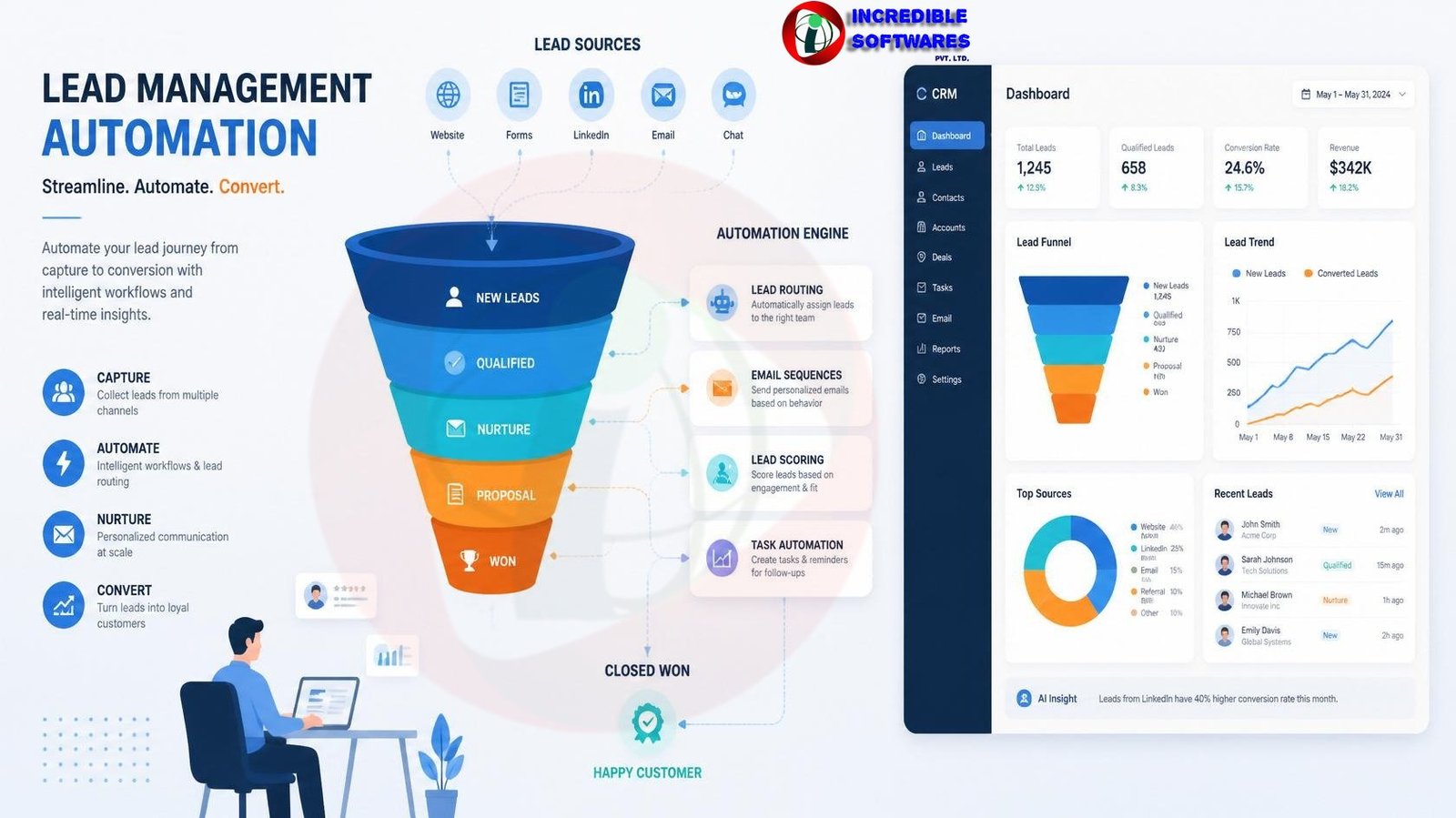
In B2B sales, timing, consistency, and follow-up can make the difference between winning a deal and losing it. Many businesses invest heavily in lead generation, but without a strong system to manage those leads, a large part of that investment is wasted.
That is where Lead Management Automation becomes valuable.
It helps businesses capture, organize, score, assign, and nurture leads in a
more efficient way. Instead of relying on manual tracking, scattered
spreadsheets, and delayed follow-ups, companies can use automation to create a
smoother and more reliable sales process. For B2B businesses, this means better
lead handling, stronger sales performance, and improved return on investment.
What Is Lead Management Automation?
Lead Management Automation is a system that helps businesses
manage leads automatically from the moment they enter the pipeline until they
are converted into customers.
It simplifies the full lead journey by automating tasks such
as:
- Capturing
leads from website forms, ads, campaigns, and landing pages.
- Scoring
leads based on interest and behavior.
- Assigning
leads to the right sales representative.
- Sending
follow-up reminders and nurturing messages.
- Tracking
performance through reports and dashboards.
In simple terms, it helps businesses handle leads faster,
smarter, and with less manual effort.
Why B2B Businesses Need It
B2B sales are usually more complex than direct consumer
sales. A single deal may take weeks or even months to close, and often involves
multiple decision-makers. That makes lead management even more important.
Without automation, businesses may miss follow-ups, delay
responses, or spend too much time on low-quality leads. Lead Management
Automation helps solve these problems by bringing structure to the sales
process.
It allows teams to:
- Respond
to leads faster.
- Focus
on high-value prospects.
- Reduce
manual work.
- Improve
communication between sales and marketing.
- Increase
conversion opportunities.
- Make
better decisions using data.
How It Improves B2B ROI
ROI, or return on investment, improves when a business gets
more results from the same or lower amount of effort and cost. Lead Management
Automation supports this in several practical ways.
Faster lead response
When a lead comes in, speed matters. Automation ensures the
lead is assigned quickly and follow-up starts without delay.
Better lead quality
Lead scoring helps businesses identify which leads are more
likely to convert. This means sales teams can focus their time and energy on
the right opportunities.
Less manual work
Automation reduces repetitive tasks such as data entry, lead
sorting, and follow-up reminders. This saves time and lowers operational cost.
Higher conversion rates
Consistent follow-up and timely engagement increase the
chances of turning leads into customers.
Clearer performance tracking
Dashboards and reports help businesses understand which lead
sources work best and where improvements are needed.
Roadmap for Using LMA in B2B Growth
A successful LMA implementation should follow a clear and
practical roadmap.
1. Review the current lead process
Start by understanding how leads are currently generated,
assigned, and followed up. Identify any delays, gaps, or missed opportunities.
2. Define lead scoring rules
Set clear qualification criteria based on factors such as
company size, industry, budget, interest level, and behavior.
3. Automate lead capture and routing
Make sure every lead is automatically captured and sent to
the right person or team.
4. Create follow-up workflows
Set up automated emails, reminders, and nurturing flows to
keep prospects engaged over time.
5. Track key metrics
Monitor conversion rate, response time, lead source
performance, and sales pipeline growth.
6. Improve continuously
Use the data to refine your process, improve messaging, and
optimize performance over time.
Subscription Model Plan for LMA
If you are selling Lead Management Automation as a product
or service, a subscription model can be highly effective. It creates recurring
revenue for your business and gives clients ongoing value.
A practical subscription structure may include:
- Starter
Plan for small businesses that need basic lead capture and follow-up
features.
- Growth
Plan for teams that need automation, lead scoring, and reporting.
- Enterprise
Plan for larger organizations that need advanced features, custom
integrations, and premium support.
To improve sales for the subscription model, focus on:
- Offering
a free demo or trial.
- Highlighting
measurable ROI benefits.
- Providing
onboarding and training.
- Showing
dashboard reports that prove value.
- Creating
upgrade paths for growing clients.
This model works well because clients can start small and
expand as their business grows, while your business benefits from long-term
recurring income.
What Can Be Improved in LMA
Even a good LMA system can deliver better results with the
right improvements.
CRM integration
The platform should connect smoothly with CRM tools, email
platforms, WhatsApp, website forms, and marketing systems.
Smarter lead scoring
Scoring should include behavioral signals such as website
visits, form submissions, and email engagement, not just basic profile data.
Better dashboards
Clients should be able to view lead source quality, sales
performance, response time, and ROI in a simple and clear dashboard.
More flexible automation
Businesses should be able to create custom workflows for
different lead types and sales scenarios.
More personalization
Automation should still feel human. Personalized emails,
segmented follow-ups, and behavior-based messages can improve engagement.
Benefits for Client Businesses
Lead Management Automation offers several direct benefits to
client businesses:
- Saves
time for sales and marketing teams.
- Reduces
missed leads and follow-up delays.
- Improves
lead quality and conversion rates.
- Increases
sales productivity.
- Provides
better visibility into business performance.
- Supports
stronger marketing and sales ROI.
For B2B businesses, these improvements can lead to stronger
pipelines, more qualified opportunities, and more predictable revenue growth.
Closing Remarks
If your business wants to improve lead handling, increase
conversions, and get better results from every sales opportunity, Lead
Management Automation is the right step forward. It brings structure to the
sales process, helps teams work more efficiently, and creates measurable
business value.
For B2B companies that want to grow in a smarter and more
organized way, LMA is not just useful — it is essential.
 Book Demo Now