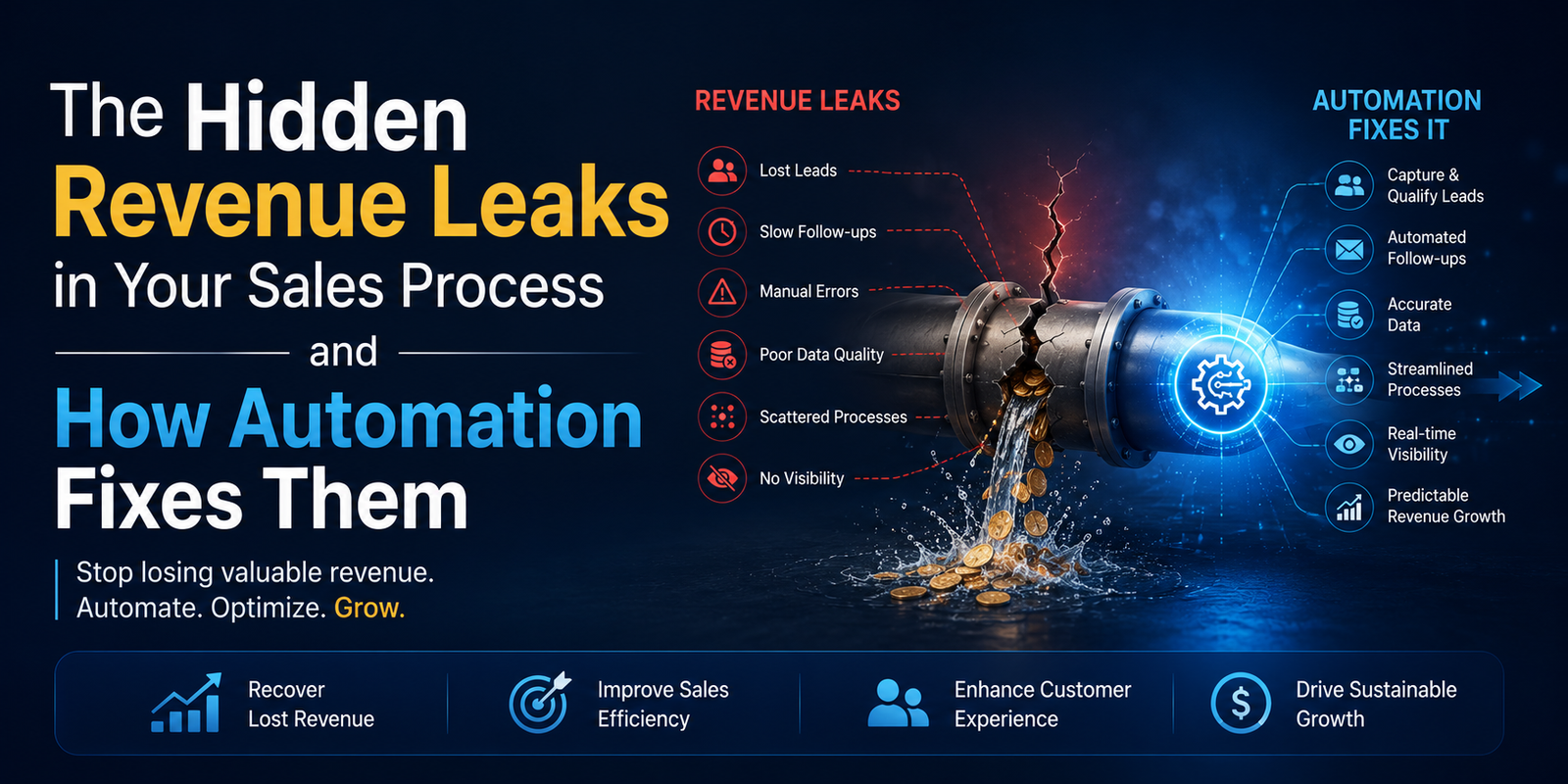
Every business invests significant resources into marketing, lead generation, and sales activities. Yet many organizations unknowingly lose thousands—or even millions—of dollars in potential revenue due to inefficiencies hidden within their sales process.
While business leaders often focus on generating more leads,
the real challenge usually lies elsewhere: managing those leads effectively and
converting them into paying customers.
Revenue leaks occur when opportunities are missed,
follow-ups are delayed, leads are forgotten, or sales teams spend more time on
administrative work than selling. Fortunately, modern sales automation systems
are helping businesses eliminate these inefficiencies and unlock sustainable
revenue growth.
In this article, we'll explore the most common hidden
revenue leaks and how sales automation can transform your sales process into a
predictable revenue-generating machine.
What Are Revenue Leaks?
Revenue leaks are preventable losses that occur when sales
opportunities fail to move through the pipeline efficiently.
Unlike obvious financial losses, these leaks often go
unnoticed because they occur gradually throughout the customer acquisition
journey.
Examples include:
- Missed
lead follow-ups
- Slow
response times
- Poor
lead qualification
- Inconsistent
sales processes
- Lack
of visibility into sales activities
- Manual
data entry errors
- Poor
lead distribution among sales teams
Over time, these issues compound and significantly impact
revenue growth.
Revenue Leak #1: Slow Lead Response Times
One of the biggest sales killers is delayed response.
When a prospect fills out a contact form, requests a demo,
or submits an inquiry, their interest is at its highest point. Every minute
that passes decreases the likelihood of engagement.
Many businesses still rely on manual processes where leads
sit in inboxes for hours—or even days—before being contacted.
How Automation Fixes It
A Sales Automation System instantly:
- Captures
incoming leads
- Assigns
them to the right sales representative
- Sends
notifications
- Triggers
automated responses
This ensures prospects receive immediate engagement,
increasing the chances of conversion.
Revenue Impact
Businesses that respond faster consistently outperform
competitors and convert more inquiries into customers.
Revenue Leak #2: Missed Follow-Ups
Research consistently shows that most sales require multiple
touchpoints before a buying decision is made.
However, many sales teams fail to maintain consistent
follow-up schedules.
Leads are forgotten, spreadsheets become outdated, and
opportunities disappear.
How Automation Fixes It
Automated workflows ensure:
- Follow-up
reminders are scheduled automatically
- Email
sequences continue nurturing prospects
- Sales
representatives receive alerts when action is required
- No
lead is left unattended
Automation eliminates dependency on memory and manual
tracking.
Case Study
A B2B software company generating approximately 500 leads
per month discovered that nearly 40% of prospects never received a second
follow-up.
After implementing automated follow-up sequences, lead
engagement increased significantly, resulting in a 28% increase in closed deals
within six months.
Revenue Leak #3: Poor Lead Qualification
Not every lead is equally valuable.
Sales teams often waste time pursuing prospects who are
unlikely to purchase while ignoring higher-value opportunities.
How Automation Fixes It
AI-powered lead scoring analyzes:
- Website
behavior
- Email
engagement
- Industry
relevance
- Company
size
- Budget
indicators
- Purchase
intent signals
The system automatically prioritizes high-value prospects.
Revenue Impact
Sales representatives spend more time selling to qualified
buyers and less time chasing low-intent leads.
Revenue Leak #4: Lack of Sales Pipeline Visibility
Many organizations operate without a clear understanding of:
- Pipeline
health
- Conversion
rates
- Sales
bottlenecks
- Team
performance
Without visibility, forecasting becomes difficult and growth
opportunities remain hidden.
How Automation Fixes It
Modern sales automation platforms provide:
- Real-time
dashboards
- Pipeline
analytics
- Conversion
tracking
- Revenue
forecasting
- Performance
reporting
Decision-makers gain actionable insights that help optimize
sales strategies.
Case Study
A growing IT services company struggled with unpredictable
monthly revenue.
After implementing sales pipeline automation and reporting
dashboards, management identified delays during proposal stages. By
streamlining approval processes, they reduced sales cycle length by 22% and
improved monthly revenue consistency.
Revenue Leak #5: Manual Data Entry Errors
Manual CRM updates consume valuable selling time and
increase the risk of inaccurate information.
Common issues include:
- Duplicate
records
- Missing
contact details
- Incomplete
lead histories
- Lost
opportunities
How Automation Fixes It
Automation synchronizes data from:
- Website
forms
- Landing
pages
- CRM
systems
- Marketing
platforms
- Email
campaigns
This creates a centralized source of truth and improves data
accuracy.
Revenue Impact
Sales teams gain more time to engage prospects and close
deals.
Revenue Leak #6: Poor Lead Distribution
Many businesses unknowingly create bottlenecks by assigning
leads manually.
Some sales representatives become overloaded while others
remain underutilized.
How Automation Fixes It
Automated lead routing assigns opportunities based on:
- Geography
- Industry
- Product
interest
- Availability
- Performance
criteria
Every lead reaches the right salesperson immediately.
Revenue Leak #7: Lack of Customer Nurturing
Many prospects are interested but not yet ready to buy.
Without ongoing engagement, they eventually choose a
competitor.
How Automation Fixes It
Automated nurturing campaigns deliver:
- Educational
content
- Product
updates
- Case
studies
- Industry
insights
- Personalized
offers
This keeps your business top-of-mind throughout the buyer
journey.
Case Study
A SaaS provider implemented automated lead nurturing
campaigns for inactive prospects.
Within one year, re-engaged leads generated more than 18% of
new customer acquisitions, creating an entirely new revenue channel.
Revenue Generation Strategy Using Sales Automation
To maximize ROI, businesses should implement the following
framework:
Step 1: Centralize Lead Sources
Connect all lead channels into one platform:
- Website
inquiries
- Paid
advertising
- Social
media campaigns
- Email
marketing
- Referral
programs
Step 2: Automate Lead Assignment
Ensure every inquiry reaches the right representative
immediately.
Step 3: Implement Lead Scoring
Prioritize opportunities based on buying intent and
engagement.
Step 4: Automate Follow-Ups
Create multi-step workflows for:
- New
inquiries
- Demo
requests
- Proposal
follow-ups
- Customer
onboarding
Step 5: Monitor Performance Metrics
Track:
- Lead-to-opportunity
conversion rate
- Opportunity-to-customer
conversion rate
- Average
response time
- Sales
cycle duration
- Revenue
per lead
Step 6: Optimize Continuously
Use analytics to identify bottlenecks and improve sales
efficiency.
The ROI of Sales Automation
Businesses that adopt sales automation often experience:
- Higher
lead conversion rates
- Faster
response times
- Increased
sales productivity
- Reduced
customer acquisition costs
- Improved
forecasting accuracy
- Greater
customer retention
- Higher
overall revenue
More importantly, automation creates a scalable sales
process that supports long-term business growth.
Closing Remarks
Hidden revenue leaks can silently drain profitability and
limit business growth. Missed follow-ups, delayed responses, poor lead
qualification, and inefficient processes all contribute to lost opportunities.
Sales automation addresses these challenges by streamlining
lead management, improving sales efficiency, and creating predictable revenue
generation systems.
In today's competitive market, businesses that automate
their sales process gain a significant advantage. By eliminating revenue leaks
and optimizing every stage of the customer journey, organizations can increase
conversions, accelerate growth, and maximize ROI.
The question is no longer whether sales automation is
necessary—the question is how much revenue your business is losing without it.
Start your free trial today and see how automated lead management can increase conversions and revenue for your business.